
Paintball works well for team building because it creates a simple shared problem: a team has an objective, limited information, changing conditions, and only a short time to decide what to do. That structure naturally requires communication, role allocation, quick planning, adaptation, cooperation, and friendly competition.
This article explains why paintball can be one of the strongest activity formats for companies, where its limitations are, and how to structure it responsibly. Readers looking for wider local context can also consult the complete Team Building Marrakech guide.
Is Paintball Good for Team Building?
Yes, paintball can be an effective team-building activity because participants need to communicate, coordinate roles, make decisions quickly, and work toward a shared objective. It works best when games are organized around team missions rather than individual performance. Paintball is particularly suitable for companies seeking active participation, strategy, friendly competition, and a shared experience. It is not the right choice for every team, however. Participant comfort, accessibility, physical intensity, safety requirements, and the company’s objective should all influence the decision.
1. Paintball Gives Teams a Clear Shared Objective
A strong team activity gives people something they must achieve together. Paintball naturally provides an objective, rules, boundaries, limited time, and visible consequences for decisions.
Depending on the format, a team might need to protect an objective, capture one, or complete a mission. The exact format should always follow the venue’s available game modes and safety rules; companies should not assume that every field runs the same missions.
The important point is that the result belongs to the team. One fast participant cannot compensate indefinitely for unclear communication or a plan nobody understands. When success is defined by mission completion rather than the number of individual eliminations, colleagues have a practical reason to coordinate.
2. Teams Need a Plan Before the Game Starts
Paintball is not purely reactive. Even a short planning period can change how the group participates.
Before a round, teams may decide who moves first, who watches key areas, who shares information, how roles are divided, and when the plan should change. The discussion does not need to be complicated. Sixty seconds is enough for participants to agree on a basic approach and confirm that everybody understands it.
This planning stage distinguishes a structured corporate game from casual play. It gives quieter participants room to contribute before the action begins and makes the later result easier to discuss: did the team follow the plan, misunderstand it, or adapt successfully?
3. Different Roles Can Matter
Paintball does not require every participant to perform the same function. One colleague may notice changes quickly, another may communicate clearly, while others contribute through planning, movement, support, or timely decisions.
This matters because a team-building format should not reward only the fastest or most confident person. A participant who moves less can still provide useful information, watch an objective, or help the team understand what is changing.
4. Communication Becomes Immediate and Practical
During a paintball game, useful communication must be short, clear, relevant, and timely. Vague information such as “someone is over there” gives teammates little direction. A clearer message—“two players on the left, moving toward the objective”—helps the group make a decision.
The activity therefore creates opportunities to practise communication under simple, visible conditions. Participants need to decide what information matters, who needs it, and how quickly it should be shared.
Paintball does not guarantee better workplace communication, but it makes the communication process difficult to ignore. Teams can hear when several people speak at once, when nobody confirms the plan, or when useful information does not reach the person who needs it.
Teams Learn Quickly Whether Their Communication Works
Paintball provides immediate operational feedback. If information arrives too late, is unclear, or is ignored, the team usually sees the consequence during the same round.
That makes the activity naturally iterative: the group can identify one communication problem, change its method, and test the adjustment in the next game.
5. Teams Have to Make Decisions With Limited Time
Teams rarely have complete information. They may not know exactly where every participant is, how the other team will move, or whether the original route remains useful. They still need to choose what to do.
This creates practical interaction around time pressure, incomplete information, and trade-offs. Should the team continue with its plan, protect its current position, or redirect attention toward the objective?
6. The Original Plan Rarely Survives Unchanged
Another team may move differently than expected. A participant may leave the round. A route may become unavailable, or the objective may require a different approach.
A good paintball team does not only plan; it notices when the plan no longer works. Participants need to share new information, reconsider responsibilities, and respond without turning every change into confusion.
7. Competition Creates Energy If It Stays Friendly
Competition gives teams a target, creates focus, and makes the outcome easy to understand. A score or completed mission can add energy without requiring a complicated event narrative.
But competition should support the corporate experience, not dominate it. Excessive emphasis on winning can create personal rivalry, embarrassment, or unnecessarily aggressive behaviour. Keep scoring simple, explain acceptable conduct, and recognize good coordination as well as the final result.
8. People Are Usually Active Rather Than Passive
Well-organized paintball keeps participants observing, communicating, deciding, moving where appropriate, and supporting teammates. Attendance becomes participation because the group’s choices influence what happens.
This advantage disappears when too many people wait while only a small group plays. Large corporate groups therefore need sensible team sizes, multiple rounds, rotations, or parallel activities where available.
The activity itself may be engaging, but participant flow determines whether the entire company experiences it. Organizers should ask how teams enter the field, what non-playing groups do, and how much time passes between rounds.
9. Paintball Creates Shared Moments Teams Can Discuss Later
A successful team move, an unexpected comeback, a clear communication moment, a funny mistake, or the final objective can become a common reference point after the event.
These moments are useful because colleagues experienced them together. They do not prove that the team has transformed, but they can make later conversation easier and give employees something beyond routine work to remember.
10. A Second Round Can Be More Valuable Than a New Activity
Companies often try to add as many activities as possible. Paintball shows why repetition with purpose can sometimes be more useful.
In round one, participants learn the game and discover where the plan is unclear. The team then takes a short pause to ask what worked and what failed. In round two, it changes one or two decisions and tests the new approach.
This creates a simple cycle: plan → act → review → adjust → try again. A second attempt can reveal more than moving immediately to an unrelated activity, because participants can see whether their adjustment made a practical difference.
Should You Debrief a Paintball Team-Building Game?
A short debrief can be useful, but it does not need to become a formal training workshop. Five practical questions are enough:
- What was our plan?
- What changed after the round started?
- Where did communication become unclear?
- What worked better in the second round?
- Did everyone understand their role?
There is no universal debrief duration. Keep it practical and avoid turning recreational paintball into forced corporate therapy.
When Paintball May Not Be the Right Team Building Activity
Paintball is not automatically suitable for every company. Another format may be more appropriate when:
- The team wants very low physical intensity.
- Some participants are uncomfortable with paintball.
- Accessibility requirements make meaningful participation difficult.
- The group strongly prefers collaboration without direct competition.
- The event objective is relaxed socialization.
- The available time does not allow briefing, equipment, play, and transitions.
Do not pressure employees to participate. A suitable alternative role or parallel activity may help in some events, but the company should choose a different main activity when a significant part of the group would feel excluded. The best team building activities in Marrakech guide can help organizers compare broader options.
How to Make Paintball More Inclusive for Corporate Groups
Start with a clear briefing and balanced teams. Use roles that value communication, observation, support, planning, and decisions—not only speed. Match the intensity to the group, include real breaks, and avoid formats in which the same confident players control every round.
For a wider participant-centered framework, see what makes a great corporate team-building experience.
Safety Comes Before Team Building
Corporate objectives never override venue safety rules. Participants must follow the official briefing, equipment instructions, mask rules, field boundaries, and staff or referee directions.
Companies should not write their own procedures that conflict with the venue. Instead, they should confirm what equipment is provided, what participants need to wear, how rules are communicated, and whether any participation requirements apply.
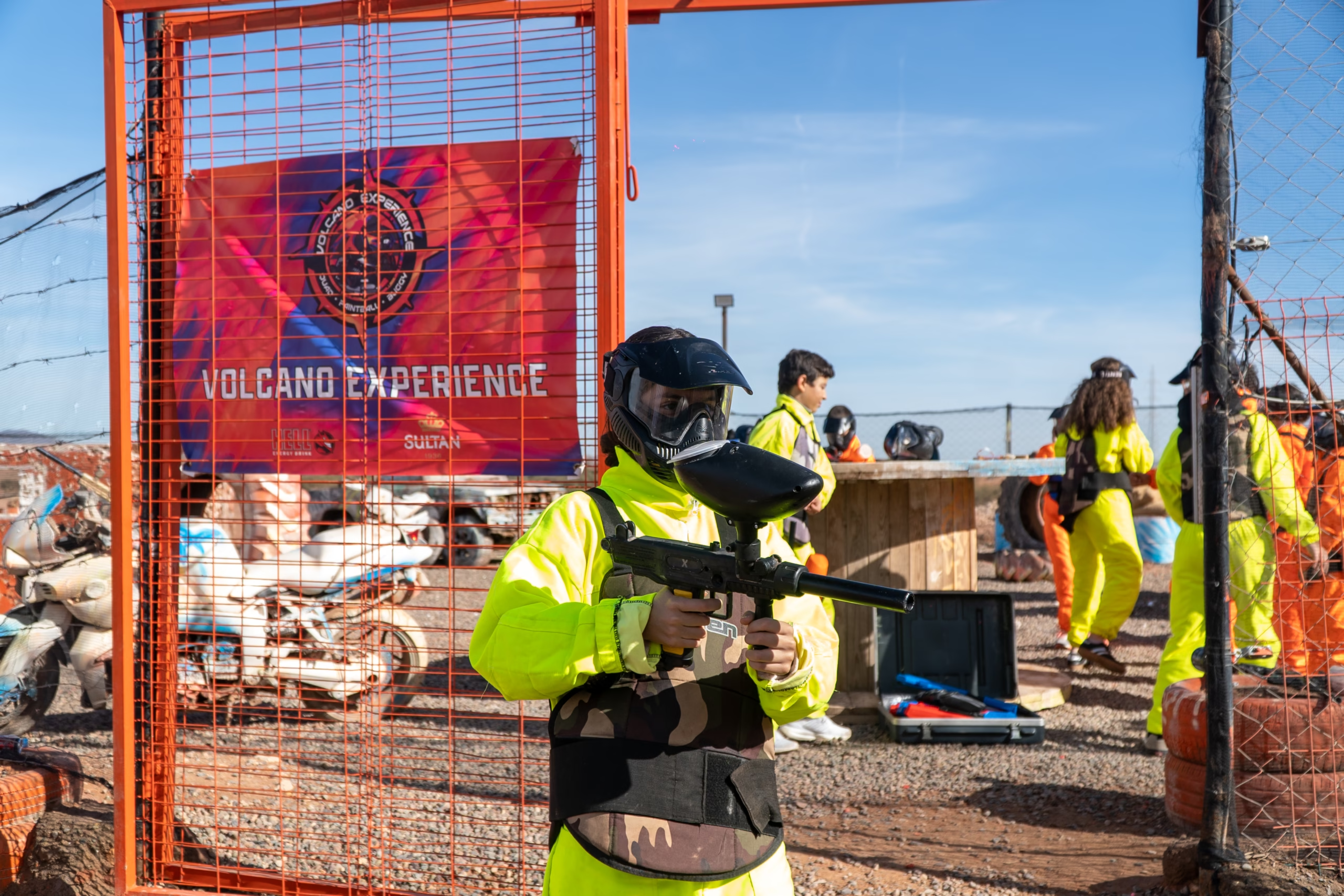
The official Volcano paintball experience currently lists a safety mask, marker, and safety briefing as included. The venue’s instructions on the day remain authoritative.
Why Paintball Feels Different From Office-Based Team Games
Paintball adds movement, a changing environment, limited time, visible consequences, and a shared objective. Communication is tied to something happening immediately rather than a hypothetical workshop scenario.
Office-based games are not inferior; they may be better for lower intensity, controlled conditions, detailed discussion, or short sessions inside a working day. The choice depends on participants and purpose.
Paintball vs Quad for Team Building
Paintball is more naturally structured around direct team interaction. Players share a mission, distribute roles, exchange information, and respond to another team’s decisions.
Quad biking in Marrakech serves a different purpose. It is better positioned as a guided shared adventure, an employee reward, or a change from the usual work environment. It should not be presented as an inferior option simply because it contains less direct collaboration.
A corporate program can also combine them: paintball provides the strategy component, while quad adds a shared adventure stage.
Where Paintball Fits Within Outdoor Team Building
Paintball is one form of outdoor team building. It is particularly suited to strategy, communication, friendly competition, and active participation.
Its usefulness still depends on team design, rotations, breaks, weather, participant comfort, and a clear objective. For the broader format—including why changing environment matters and how outdoor events differ from indoor sessions—read why outdoor team building works.
Can Paintball Work for Large Company Groups?
Yes, if the event is structured properly. Large groups may need smaller teams, multiple rounds, scheduled rotations, parallel activities where available, and a clear scoring system.
Ask how many teams will play, how transitions work, and what participants do while waiting. Do not rely on an assumed capacity number; the workable format depends on the venue setup, chosen session, staffing, and complete event structure.
Companies that need to coordinate paintball with other activities can review Volcano’s corporate team-building activities and discuss group organization before requesting a proposal.
Can Small Teams Use Paintball for Team Building?
Yes. Small teams can use simpler missions, short planning periods, repeated rounds, and direct communication. Because fewer people are involved, every participant’s role may become more visible.
Example Paintball Team Building Format
Illustrative example not a fixed Volcano Experience package.
Welcome and safety briefing
↓
Team formation
↓
Round 1
↓
Short team discussion
↓
Round 2 with an adjusted strategy
↓
Final mission
↓
Short debrief, scores, or group moment
This progression gives participants time to understand the rules, test a plan, adapt, and finish together. Exact timing, game modes, staffing, and availability must be confirmed with the provider. For the wider operational process, use the guide on how to organize a team-building event.
Simple Ways to Make Paintball More Team-Oriented
- Use a shared objective. Score mission completion rather than only individual eliminations.
- Give teams planning time. Even one short discussion improves clarity.
- Assign simple responsibilities. Make communication, observation, and support meaningful.
- Run a second attempt. Let teams adjust one part of their approach.
- Mix teams deliberately. Cross-department groups can create new interaction when that matches the event objective.
These are design principles, not claims about Volcano’s available game modes. Companies wanting a larger library of non-paintball formats can consult the separate “15 Fun Team Building Challenges for Work Teams” article once it is published.
Common Mistakes When Using Paintball for Team Building
Treating It as Individual Elimination Only
Problem: Individual performance replaces the shared mission. Better approach: Score a clear team objective and recognize coordination.
Creating Unbalanced Teams
Problem: One side dominates before strategy matters. Better approach: Balance teams thoughtfully and adjust between rounds where appropriate.
Giving No Planning Time
Problem: Participants enter without shared roles or direction. Better approach: Allow a short pre-round discussion.
Making Competition Too Serious
Problem: Energy becomes personal pressure. Better approach: Keep the score transparent, conduct respectful, and outcome proportionate.
Ignoring Participant Comfort
Problem: Employees feel pressured or excluded. Better approach: communicate requirements early and consider alternatives when necessary.
Allowing Too Much Waiting Between Rounds
Problem: Active participation turns into passive attendance. Better approach: confirm rotations, transition time, and what waiting groups will do.
Starting Without a Clear Objective
Problem: The game becomes unstructured individual play. Better approach: explain the mission before teams plan.
Giving Teams No Chance to Adapt
Problem: Participants cannot apply what they learned in round one. Better approach: include a short review and second attempt.
Ending Immediately Without Closure
Problem: The event simply stops after the final whistle. Better approach: finish with scores, recognition, a group moment, or a brief recap.
Paintball Team Building at Volcano Experience
Volcano Experience offers outdoor paintball near Marrakech and has a dedicated corporate and team-building offer. The official paintball page currently presents 100-ball and 200-ball sessions, with a marker, safety mask, and briefing included.
The public page currently lists:
- 100 balls: 150 MAD
- 200 balls: 250 MAD
These are current published activity prices, not necessarily the final price of a customized corporate team-building event. For the distinction between activity prices and complete event budgets, see team building costs in Marrakech.
What to Tell Volcano When Planning Corporate Paintball
Provide:
- Preferred date
- Approximate group size
- Preferred duration
- Main team-building objective
- Desired competition level
- Transport requirements
- Relevant participation or organizational requirements
This information allows Volcano to discuss a suitable format without promising a fixed structure before the company’s needs are understood.
Plan a Paintball Team Building Event in Marrakech
Paintball can be one of the strongest team-building activities when the event is built around a shared objective, a short planning stage, clear roles, practical communication, friendly competition, and an opportunity to adapt.
Companies looking for an active, strategy-based format can explore paintball in Marrakech and Volcano’s team-building events in Marrakech. To discuss your date, group size, objective, and practical requirements, contact Volcano Experience.
FAQ — Paintball for Team Building
Is paintball good for team building?
Yes. Paintball can create opportunities to practise communication, planning, role distribution, decision-making, and adaptation. It works best when the game uses a shared team objective and participants have time to plan and review their approach.
What teamwork skills does paintball use?
Paintball uses clear communication, observation, coordination, quick decisions, role allocation, support, and adaptation. Different formats emphasize different contributions, so companies should discuss the objective and game structure with the organizer.
Does paintball improve communication?
Paintball does not guarantee lasting improvement, but it creates a practical setting in which teams can test whether information is clear, timely, and understood. A second round allows participants to adjust how they communicate.
Can paintball work for large groups?
Yes, when teams, rounds, rotations, transitions, and waiting time are organized properly. The workable format depends on the venue and program, so companies should not assume a universal capacity.
Is paintball suitable for small teams?
Yes. Small groups can use simple missions, repeated rounds, and short planning discussions. Confirm the workable player format and availability directly with the venue rather than relying on a universal minimum.
Does paintball need to be competitive?
Paintball naturally contains competition, but it does not need to focus on individual elimination. Shared missions, team scoring, mixed groups, and recognition for coordination can keep the emphasis on the team.
How can you make paintball more team-oriented?
Use a shared objective, allow planning time, give participants simple responsibilities, keep scoring team-based, and include a second round after a short discussion. These changes move the activity away from unstructured individual play.
Is paintball suitable for every employee?
No. Some employees may prefer lower physical intensity, feel uncomfortable with the activity, or have accessibility requirements that affect participation. Do not pressure people; consider alternatives or another main activity when necessary.
How long should a paintball team-building event last?
There is no universal duration. Allow enough time for arrival, safety briefing, equipment, team planning, play, transitions, and closure. Larger groups and repeated rounds generally need more time than a single recreational game.
How much does paintball cost at Volcano Experience?
The official page currently lists 150 MAD for 100 balls and 250 MAD for 200 balls. These are published activity prices, not a guaranteed quotation for a customized corporate event.
How can companies book paintball team building in Marrakech?
Send Volcano Experience the preferred date, approximate participant count, objective, desired duration, competition level, transport needs, and relevant requirements. The team can then discuss the activity and corporate event format.