

Choosing a team building company in Marrakech is not simply a matter of finding the longest activity list or the lowest price. The provider must understand why the company is organizing the event, who will participate, how teams will move, what the schedule must accommodate, and which responsibilities belong to each party.
A good provider should be able to explain the event from arrival to departure. That includes the briefing, team allocation, activity flow, rotations, breaks, logistics, supervision, and response to changes. The right choice may be an activity venue, a specialist, or a broader event agency, depending on the scope.
This guide gives HR managers and corporate organizers a practical framework for comparing providers. It focuses on operational capability and proposal quality rather than generic team-building benefits. For broader context, use the complete Team Building Marrakech guide, then return here when you are ready to evaluate who should deliver the event.
How Do You Choose a Team Building Company in Marrakech?
Choose a team-building company by assessing its corporate-group experience, understanding of your objective, activity suitability, customization, group-management system, venue, logistics, safety organization, communication, and proposal transparency. Ask each provider to explain how your specific event would work, not merely send an activity list. The best provider for your company is the one that can give clear, credible answers from participant arrival through activities, transitions, and departure.
Before Comparing Companies, Define What You Need
Give every shortlisted provider the same brief. Otherwise, one may quote for transport and refreshments while another quotes only for activities, making the prices impossible to compare fairly.
You do not need a finished event plan. You need an approximate date, participant count, duration, objective, budget range, desired intensity, location preference, and any transport or food requirements. For the detailed preparation process, add: [INTERNAL LINK: How to Organize a Successful Team Building Event in Marrakech].
Simple Team Building Brief
Company:
Preferred date:
Approximate participants:
Primary objective:
Available duration:
Budget range:
Preferred format or intensity:
Transport requirements:
Food or refreshment requirements:
Other relevant requirements:
Send the same version to each provider and record any assumptions they make. A provider that asks useful questions before recommending a program is already giving you evidence about its working process.
1. Does the Provider Understand Corporate Groups?
Running an activity for a small private group is not automatically the same as organizing a corporate event. Corporate groups may need team allocation, simultaneous stations, consistent briefings, fixed departure times, participant information, and coordination with HR or an agency.
Ask whether the provider has organized company or team events and request examples of relevant formats. The provider should be able to explain how groups were divided, how several teams were kept active, and how timing and transitions were managed.
Relevant experience matters more than company size. A smaller provider with a clear system may suit a focused event better than a large supplier that treats the group as a standard booking.
2. How Does the Provider Design the Event?
A weak first conversation begins with: “Choose Activity A, B, or C.” A stronger conversation begins with questions:
- What should the event achieve?
- How many people will attend?
- How much time is available?
- Should the format emphasize competition, collaboration, or reward?
- Are there different participation or accessibility needs?
- Does everyone need to participate at the same time?
Activity selection should follow the objective. If the goal is cross-department interaction, the provider should discuss team composition and shared tasks. If the goal is employee reward, an intense tournament may be less appropriate than a varied, lower-pressure format.
Ask the provider to describe the event as a sequence. If it can explain the welcome, briefing, activity rounds, transitions, breaks, and closing, you are evaluating an event design rather than purchasing disconnected activities.
3. What Does “Customized Team Building” Really Mean?
Customization should describe operational choices, not only adding a logo to a sign. Depending on the event, it may involve team size, activity order, intensity, session length, scoring, rotations, breaks, or the balance between competition and collaboration.
Not every event needs deep customization. A short outing for a small team may work well with a proven standard format. A large group with a precise business schedule and mixed participation needs may require more adaptation.
Ask exactly what can change and what remains fixed. This prevents “fully customized” from becoming a vague sales phrase and helps the provider price the real work involved.
4. Is Activity Quality More Important Than Quantity?
Yes. A provider offering 30 activities is not automatically better than one offering fewer activities with clear organization. For every recommended option, ask:
- Why does it suit our objective?
- How many people participate at once?
- How long is each round?
- What do other participants do while waiting?
- Can intensity or roles be adapted?
- How do teams move to the next activity?
The answer reveals activity throughput: how many people can meaningfully participate within the available time. This is often more important than the total number of activities shown in a brochure.
Readers seeking ideas can use [INTERNAL LINK: Best Team Building Activities in Marrakech for Companies]. When choosing a provider, return to the operational question: can this company deliver the selected activity effectively for your group?
5. How Will the Provider Handle Your Group Size?
Ten participants and a much larger corporate group cannot automatically follow the same structure. Ask whether the group will be divided, how many teams and stations will operate, and whether participants remain active throughout the program.
Request a simple participant-flow explanation. Where does each team begin? Where does it go next? How long does it wait? Where are breaks taken? A provider should not need to reveal every game to answer these questions.
Avoid relying only on a stated maximum capacity. Capacity tells you how many people may fit; it does not tell you how well they will participate.
6. Can the Provider Explain Its Rotation System?
A common structure is:
Team A → Activity 1
Team B → Activity 2
Team C → Activity 3
Then all teams rotate.
Evaluate equal session time, transition time, waiting, briefing, station supervision, and consistent scoring where relevant. Ask what signal starts a rotation and who controls the master schedule.
The purpose is not to design the rotation for the provider. It is to see whether the provider has already considered bottlenecks and can explain its operating system clearly.
7. Is the Venue Suitable for the Whole Event?
Good activities can still produce a poor experience when participant flow is weak. Evaluate the complete venue, not only the main activity area.
Ask where the group arrives, checks in, receives the briefing, rests, and departs. Confirm whether there is enough usable space, suitable facilities, parking or transport access, and practical movement between stations. For deeper outdoor context, add: [INTERNAL LINK: Outdoor Team Building in Marrakech: Why It Works].
If possible, request a plan, video, or visit. The goal is to understand distances and flow, not merely inspect the scenery.
8. Who Handles the Logistics?
Clarify responsibility for transportation, meeting points, arrival, check-in, equipment distribution, briefings, breaks, transitions, and departure. Some services may be included; others may remain with the company or an external agency.
Ask one direct question: Which responsibilities belong to the provider, and which belong to us? Put the answer in writing.
For example, “transport available” is not enough. Confirm whether it is included, optional, arranged by the provider, or simply something the company must organize independently. The same principle applies to food, drinks, photography, branding, and awards.
9. How Are Safety and Supervision Organized?
Ask specific operational questions rather than accepting a general promise that everything is safe:
- How are participants briefed?
- Who supervises each activity?
- What equipment is provided?
- Are there participation requirements?
- How are rules communicated?
- What options exist for someone who does not want a particular activity?
- What happens if conditions require a schedule change?
The provider should answer within the scope of the selected program. Do not assume that a website logo, general statement, or attractive equipment photograph proves a certification or a particular standard. Request the information your company actually needs before approval.
10. What Does Pre-Event Communication Reveal?
Pre-event communication is part of the service. Evaluate whether replies answer the question, whether assumptions are stated, and whether changes are confirmed in writing.
Fast responses are useful, but clear responses matter more than speed alone. A provider that replies quickly without addressing participant count, timing, or inclusions may create extra work later.
Confirm one contact person for the planning period and event day. Ask how schedule changes will be communicated and what information the provider expects HR to send participants.
11. What Should a Clear Proposal Include?
A useful proposal should allow the company to understand exactly what it is buying. Depending on the event, it should clarify:
- Date and participant count used for the quote
- Objective and proposed format
- Activities and sequence
- Estimated schedule and duration
- Included and optional services
- Transport where relevant
- Pricing structure
- Payment requirements
- Change or cancellation conditions where applicable
- Information still required from the company
The proposal does not need to be long. It needs to remove ambiguity. If a service appears in a presentation but not in the priced proposal, ask whether it is included before comparing totals.
12. Why Should You Avoid Comparing Price Alone?
Two proposals with similar titles may contain different durations, activities, staffing, transport, food, venue access, or customization. Compare like with like.
| Provider | Price | Duration | Activities | Transport | Food | Group Management | Customization | Notes |
|---|---|---|---|---|---|---|---|---|
| Provider A | ||||||||
| Provider B | ||||||||
| Provider C |
The lowest proposal may be appropriate if the company needs a simple activity. A higher proposal may offer necessary coordination. The question is not “Which costs least?” but “Which delivers the required event with transparent inclusions?”
13. Is There Evidence of Real Group Events?
Useful proof can include real event photographs, group videos, corporate-event pages, detailed reviews, case studies, and social content from actual events. Look for evidence of briefings, teams, stations, participant flow, and organized group moments—not only close-up action shots.
A polished website does not prove operational experience. Social-media popularity does not prove corporate-event capability either. The evidence should match the service you are evaluating.
When a provider presents a previous event, ask what part it managed. It may have supplied one activity, the entire venue program, or broader logistics. Those are different levels of responsibility.
14. How Should You Read Reviews?
Do not choose automatically by the highest rating. Read for details about organization, staff communication, group handling, timing, activities, transport, and problem resolution.
A large collection of tourist reviews may confirm that individual activities are enjoyable. It may say less about corporate coordination than a smaller number of detailed group-event reviews. Look for references to teams, schools, associations, or company groups where authentic.
Treat one review as a data point, not a guarantee. Compare the pattern across several reviews with the provider’s proposal and direct answers.
15. What Happens When the Plan Changes?
Ask how participant-count changes, weather, late arrival, transport delays, or activity timing would affect the program. The useful question is: What can be adjusted, what cannot, and when must a decision be made?
Flexibility does not mean every change must be free or possible. It means the provider communicates constraints, consequences, and available alternatives before the event.
Red Flags When Choosing a Team Building Provider
A red flag is a reason to ask more questions, not always a reason to reject the company immediately.
- Activities are recommended before your objective is discussed. Ask how the recommendation supports your goal.
- Inclusions are unclear. Request one written list of included and optional services.
- Large-group management cannot be explained. Ask for the team and rotation structure.
- Business outcomes are guaranteed. Activities can support an objective, but no provider can guarantee workplace results from one event.
- Timing remains vague. Request an arrival-to-departure outline.
- Supervision answers are general. Ask who briefs and monitors each activity.
- There is no relevant group evidence. Request examples related to events, not only individual bookings.
- Everything is called customized. Ask which operational elements will actually change.
- Low price is the only argument. Compare duration, inclusions, and group management.
- Communication is already confusing. Confirm a single contact and written version of the plan.
15 Questions to Ask Before Booking
- Have you organized events for groups similar to ours?
- What information do you need before recommending a program?
- How would you structure an event for our group size?
- How will participants be divided?
- How do activity rotations work?
- How much waiting time should we expect?
- What exactly is included in the proposal?
- Who supervises each activity?
- What participant requirements should we know?
- How is transportation handled?
- What happens if our participant count changes?
- What happens if weather affects the program?
- Can the schedule fit our company agenda?
- What information should employees receive beforehand?
- Who is our contact before and during the event?
Team Building Company Comparison Scorecard
Score each criterion from 1 (weak) to 5 (excellent). Add notes beside the number so the decision remains evidence based.
| Criterion | Provider A | Provider B | Provider C |
| Understanding of objective | |||
| Corporate-group experience | |||
| Activity suitability | |||
| Customization | |||
| Group management | |||
| Rotation plan | |||
| Venue suitability | |||
| Logistics | |||
| Safety explanation | |||
| Communication | |||
| Proposal clarity | |||
| Price transparency | |||
| Evidence of events | |||
| Flexibility | |||
| Overall fit |
Do not automatically select the highest raw score. Weight what matters. A multi-day international event may place more weight on logistics, while a focused half-day activity may prioritize venue, rotations, and supervision.
Activity Venue, Event Agency, or Team Building Specialist?
Activity Venue
An activity venue operates its own physical location and one or more experiences. It may suit a company seeking a dedicated activity day, straightforward logistics, and direct knowledge of the site.
Event Agency
An event agency may coordinate multiple venues, suppliers, accommodation, transport, entertainment, and production. It can be useful when the event extends well beyond team activities.
Team Building Specialist
A specialist may focus on facilitated exercises, structured challenges, and team-development formats. It may operate at different venues or partner with activity suppliers.
None is automatically better. Choose according to scope, provider evidence, and who must own the full event. For wider formats, add: [INTERNAL LINK: Company Events in Marrakech: Top Activities for Your Team].
When May an Event Agency Make More Sense?
An agency may be appropriate when the company needs hotel coordination, conference space, a gala dinner, several external suppliers, destination management, or a multi-day program. In that situation, the activity provider may be one supplier within a larger production.
When May an Activity-Based Provider Make More Sense?
An activity-based provider can suit a company whose core requirement is structured group activities, an outdoor outing, rotations, challenges, or a half-day or full-day activity program. Direct venue knowledge can simplify timing and participant flow, provided the provider demonstrates suitable corporate organization.
Considering Volcano Experience for Team Building in Marrakech
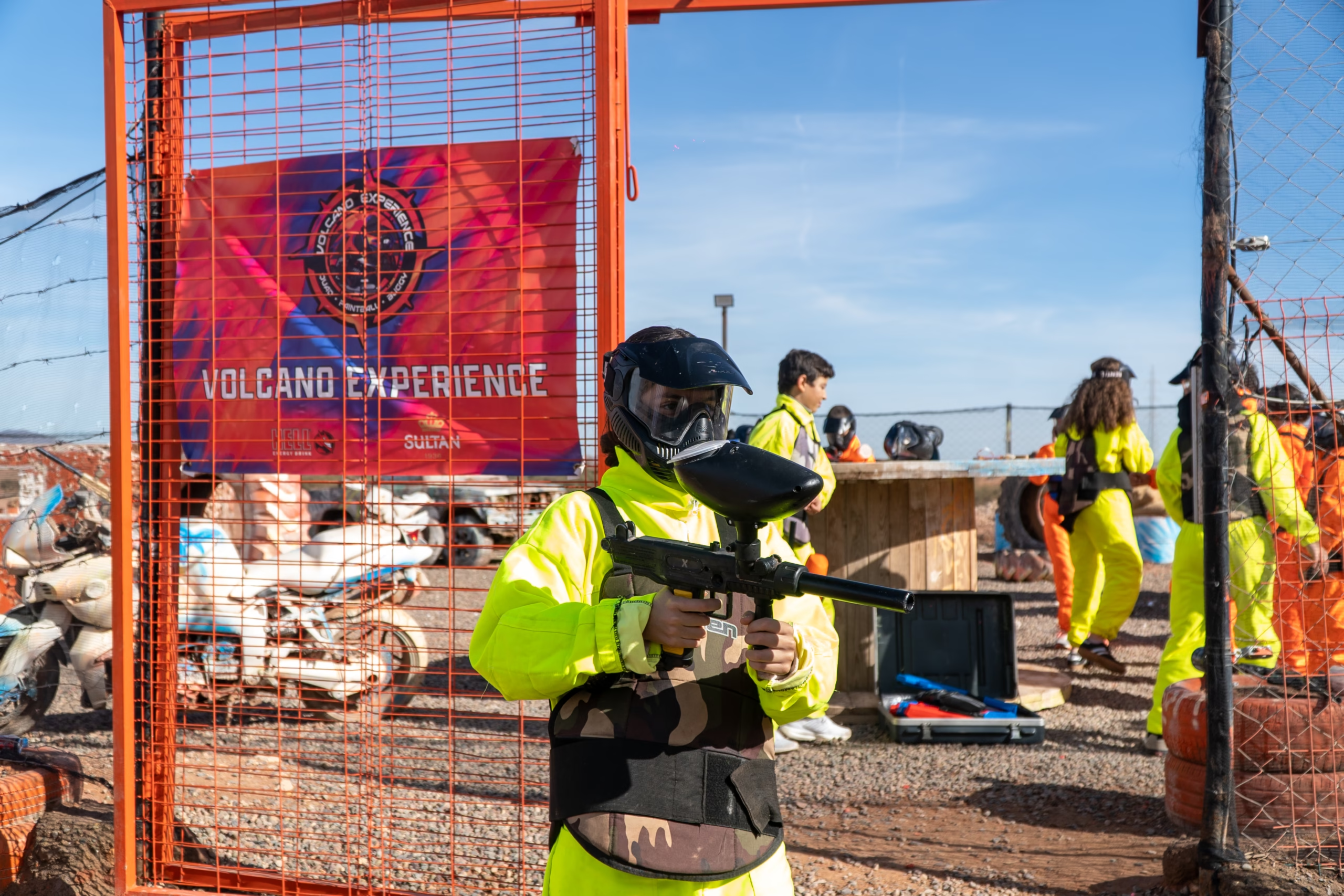
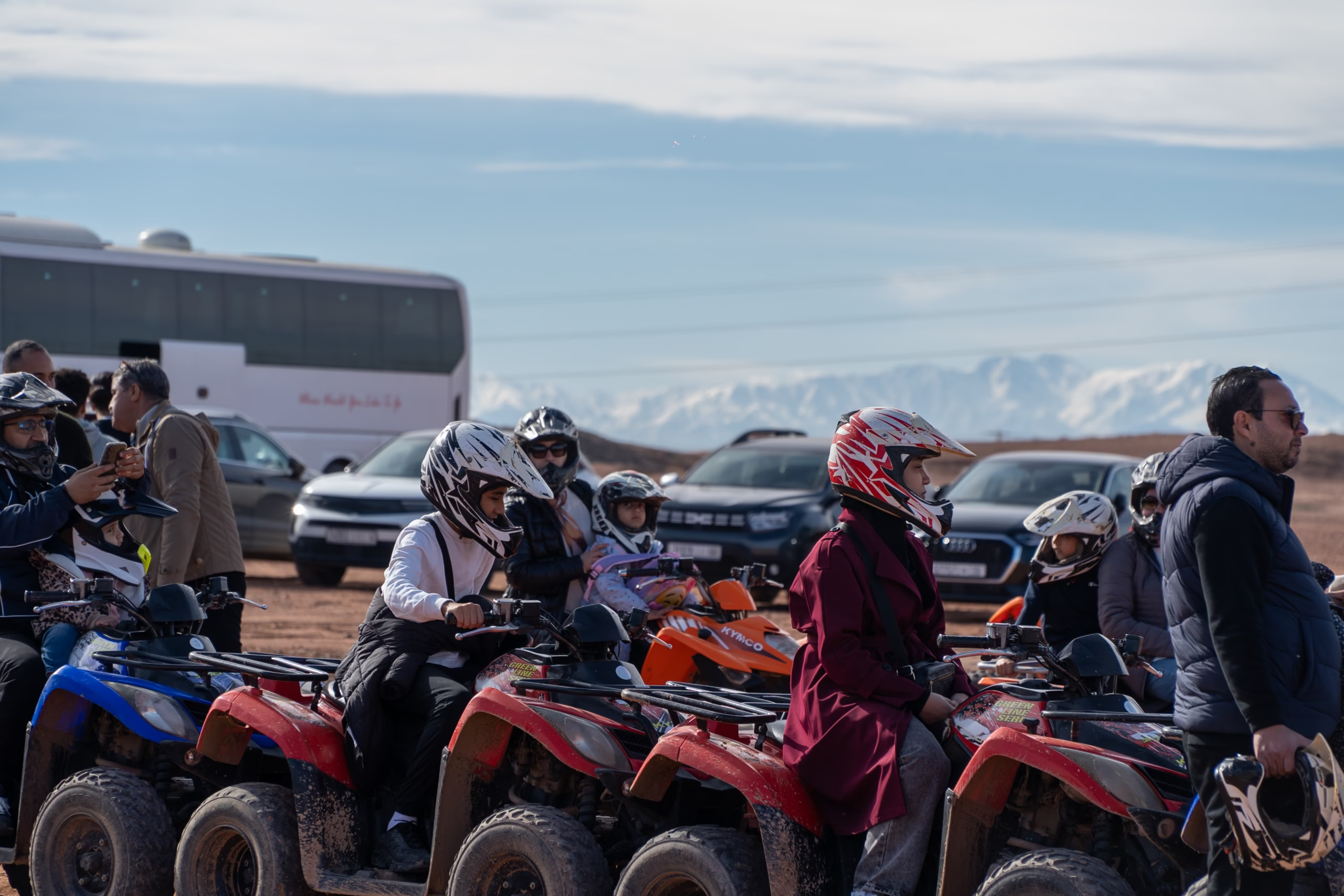
Volcano Experience operates activity and group experiences in Marrakech. Its official website presents paintball, quad biking, buggy experiences, team challenges, and group-oriented outdoor formats. It also has a dedicated page for team building and corporate events in Marrakech.
The website shows team-building content for companies, schools, and groups, together with published group-event material on its previous team-building events page. This is relevant evidence to review, but companies should still request a proposal for their own date, size, objective, and requirements.
Volcano should be evaluated using the same criteria as any shortlisted provider: event design, team division, rotations, venue flow, logistics, supervision, inclusions, communication, and contingency. Its suitability depends on the company’s event scope—not on an unsupported claim that one provider is best for every brief.
Questions to Discuss With Volcano Before Requesting a Proposal
Provide the participant count, preferred date, objective, available duration, desired event style, transport requirements, approximate budget where appropriate, and relevant participant constraints.
Then ask the team to explain:
- Recommended format and activity sequence
- Team division and rotation system
- Timing from arrival to departure
- Included and optional services
- Transport and other logistics
- Information employees should receive
- What can change if conditions affect the plan
This gives both sides a clearer basis for a useful proposal than a message asking only for “team building prices.”
FAQ: Choosing a Team Building Company in Marrakech
How do I choose a team building company in Marrakech?
Give shortlisted providers the same brief, then compare corporate-group experience, objective understanding, activity suitability, rotations, venue, logistics, safety organization, communication, evidence, and proposal clarity. Choose the provider that can explain how your specific event will work, not simply the one with the longest activity list.
What should a team building company provide?
The exact scope varies, but the proposal should clarify activities, schedule, group organization, supervision, included services, optional services, pricing, and responsibilities. The provider should also state what it needs from the company and how changes or relevant contingencies will be handled.
How do I compare team building proposals?
Standardize the brief and compare the same fields: duration, activities, transport, food, venue, supervision, group management, customization, and conditions. Record assumptions and optional items separately. Totals are meaningful only when the proposals include comparable services.
Should I choose the cheapest team building provider?
Not automatically. A lower price may suit a simple event, but it may exclude transport, coordination, food, or customization included elsewhere. Select the proposal that meets the required objective and service scope with clear pricing, rather than assuming the lowest or highest price represents the best value.
What questions should I ask before booking?
Ask about relevant group experience, event structure, team division, rotations, waiting time, supervision, inclusions, participant requirements, transport, weather changes, schedule flexibility, and the event-day contact. The answers should be specific to your group rather than generic promises.
How can I check corporate-event experience?
Review real group photographs or videos, event pages, detailed group reviews, case studies, and direct examples. Ask what the provider actually managed in each event. Website quality and social popularity can support credibility, but neither alone proves operational experience with corporate groups.
What is the difference between a team building company and an event agency?
A team-building specialist focuses on structured group activities and facilitation. An activity venue operates experiences at its location. An event agency may coordinate hotels, venues, suppliers, production, and multi-day programs. The correct choice depends on how much of the wider event one supplier must manage.
Can a team building company organize large groups?
Some can, but do not rely only on a stated capacity. Ask how participants will be divided, how many stations operate, how long rotations last, where teams move, and how waiting is controlled. The operating plan matters more than the maximum number alone.
Should team building activities be customized?
Customization should match the event’s complexity. It may involve team sizes, sequence, intensity, scoring, rotations, or breaks. A small, short event may not require extensive changes. Ask what will be adapted, why it supports the objective, and whether it affects price or timing.
How do I request a team building proposal in Marrakech?
Send the company name, preferred date, approximate participant count, primary objective, available duration, transport needs, budget range where appropriate, and relevant requirements. Ask for a written program showing the schedule, activities, inclusions, options, responsibilities, and total pricing basis.
Request a Team Building Proposal in Marrakech
The best team building company in Marrakech is not a universal winner. It is the provider whose experience, venue, operating system, communication, and proposal fit your specific company event.
A useful enquiry should include the company name, date, participant count, objective, duration, transport needs, and relevant requirements. Companies considering an activity-based format can review Volcano Experience team building and contact Volcano Experience to discuss the brief and request a proposal.